Candice Hutchings adapts pastéis de nata with coconut milk, starches and kala namak, while cinnamon sugar and rolled puff pastry build a flaky shell.
Vegan pastéis de nata hinge on a familiar pastry trick and a less familiar custard one. Canadian creator Candice Hutchings, the YouTuber behind Edgy Veg, starts with puff pastry that may already be plant-based, then builds an egg-free filling from coconut milk, starches and seasonings chosen to evoke the color and savory depth of egg custard. Her approach makes the recipe interesting beyond the substitution: it treats the pastry and filling as separate problems, each solved with ingredients that are relatively easy to find.
Hutchings developed the custard from a crème brûlée recipe she had already published and included in her cookbook. “I’m going to take the base of that recipe and kind of really try and bring out an eggy flavor,” she says. That gives the tarts a practical starting point: rather than attempting to reproduce every element of a traditional recipe, she adapts a tested custard base and tunes its flavor for pastéis de nata.
Read more: Chai-Spiced Custard Tart With Mango
A flaky shell without specialty molds
For more vegan recipes, follow Edgy Veg on her YouTube Channel.
The pastry starts with thawed sheets of puff pastry. Some commercial puff pastry is made with oil rather than butter, Hutchings points out, which means it can be vegan “by accident.” The useful move is to check the ingredients rather than assume the pastry requires a specialty product.
Before shaping, she sprinkles cinnamon sugar over the pastry. It’s optional, but it adds a little sweetness and spice to the shell. She rolls the sheets into tight logs, wraps them and chills them in the refrigerator. Once firm, the logs are sliced into portions and pressed into a standard muffin tin, with the pastry rising slightly above each cup’s rim.
The rolling method is meant to encourage extra layers in the baked shell. “What I’m hoping with the whole rolling situation is that we get some added flakiness,” she says. Using a muffin tin also keeps the method accessible to home cooks who don’t have individual tart molds. The key is shaping each pastry portion into a cup that can hold the filling, rather than trying to reproduce the traditional equipment.
Coconut milk, starch and a controlled set
In a conventional pastel de nata, egg custard sits inside crisp pastry. Hutchings’ version needs to thicken without eggs, so she uses two mixtures: coconut milk infused with cinnamon, and a separate blend of unsweetened soy milk with tapioca starch and cornstarch. The starches do the structural work, helping the filling develop a thick, smooth consistency as it heats.
She briefly simmers the coconut milk with sugar and a cinnamon stick, then lets the spice steep. Infusing the liquid gives cinnamon a presence in the custard without adding ground spice directly. The coconut base could bring its own strong flavor, and Hutchings acknowledges that it may be detectable. Her intention is to balance it with the other additions.
The starch mixture is whisked into the warm coconut mixture gradually. Continuous whisking matters as the custard approaches a simmer and begins to thicken; the aim is a filling that can be spooned into the shells before it sets. Hutchings says cornstarch alone can stand in if tapioca starch isn’t available, which gives cooks some flexibility while keeping the basic method intact.
Recreating the flavor and golden color
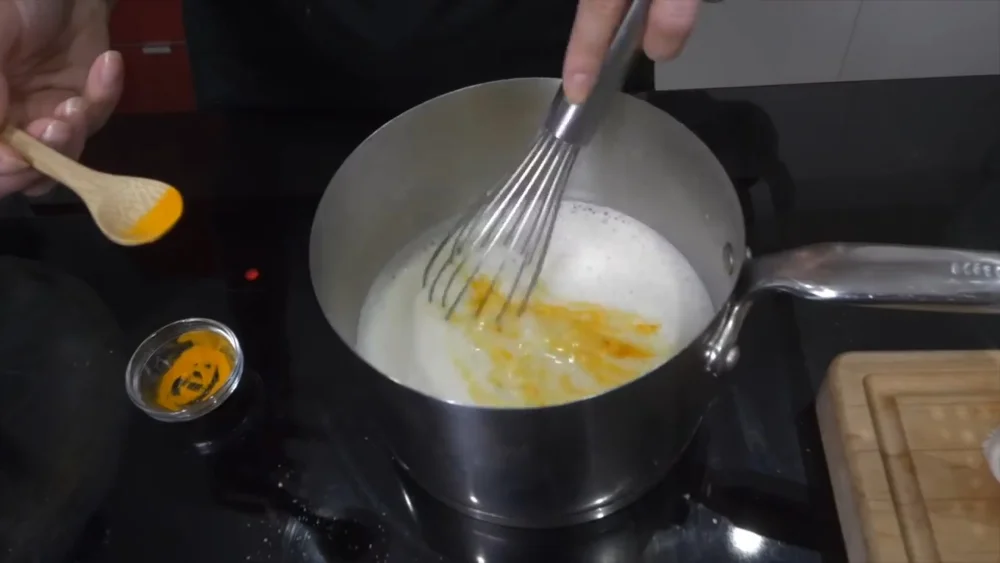
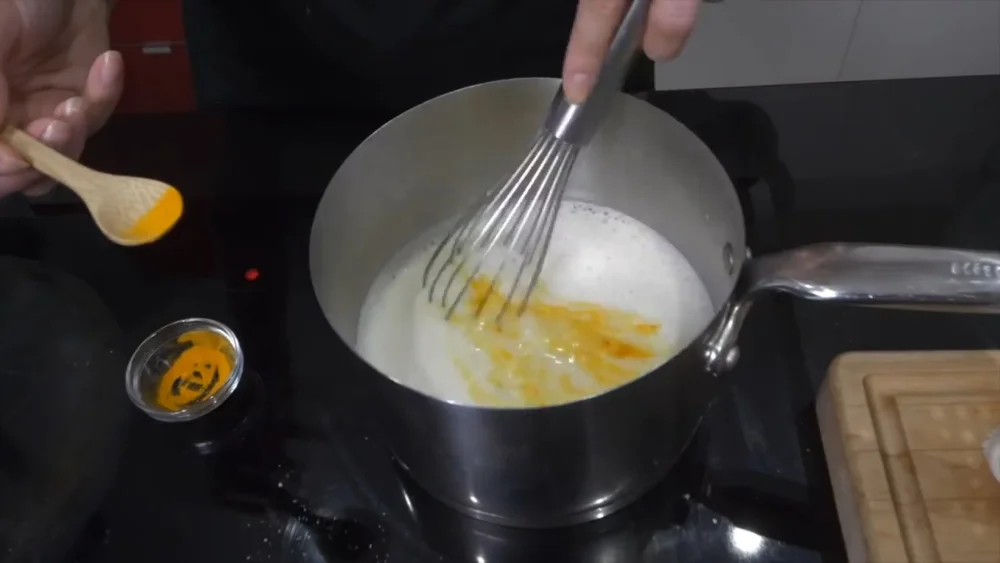
Texture alone won’t make an egg-free custard read like the original. Hutchings adds nutritional yeast for a rich, buttery note, describing it as part of the “distinct eggy buttery flavor” associated with egg yolk. Vanilla adds another layer, while turmeric gradually brings the mixture toward the characteristic golden-yellow shade. She adjusts the turmeric as the custard cooks instead of adding a fixed amount all at once.
The more distinctive flavor tool is kala namak, or black salt. Hutchings describes it as an Indian salt with a sulfuric smell and taste. That quality is commonly used in vegan cooking to suggest cooked egg, and here it supplies an aromatic cue that coconut milk and starch cannot provide on their own. She recommends adding the salt little by little and tasting between additions, since the desired level of egg flavor is a matter of preference.
Her own verdict after tasting the custard is concise: “It’s perfectly eggy for me.” The result depends on the combined effect of the seasonings, not on a single substitute. Nutritional yeast contributes richness, turmeric supplies color, and kala namak pushes the flavor toward egg. That layered approach is what distinguishes this filling from a plain sweetened coconut pudding.
Read more: This Crème Brûlée is 100% Vegan
Bake until set, then let the tarts rest
Once the custard thickens, Hutchings fills the pastry shells promptly, before the mixture becomes difficult to portion. She estimates two to three tablespoons per tart and suggests spreading the filling evenly before topping up individual shells. The method helps keep the portions consistent, although she later admits that her own batch was slightly overfilled. “I’m not upset about it because who doesn’t love custard?” she says.
The tarts bake for about 15 to 20 minutes, with the exact timing depending on the oven. Hutchings is aiming for crisp pastry and set custard, along with the dark, blistered tops associated with pastéis de nata. The appearance matters here because the browned surface is part of what makes the pastry recognizable, not just a finishing detail.
After baking, she leaves the tarts in the muffin pan for around 10 minutes, then transfers them to a wire rack. That pause gives the custard time to firm up and makes the delicate pastries easier to move without breaking apart. Between the readily available pastry, a flexible starch blend and carefully adjusted seasonings, Hutchings’ recipe offers a clear route to a vegan version that takes its cues from the original’s texture, color and flavor.
The broader takeaway is that the recipe’s success rests on managing several small decisions: checking the puff pastry label, chilling the rolled dough, whisking the starches into the custard, and adding kala namak and turmeric gradually. Those choices give home cooks room to adjust the result while keeping the defining features of the tart in view: flaky pastry, a rich filling and a browned top.
Please note: PBN runs a sponsored content model. To explore how you can get featured, please email [email protected] or visit everkinddigital.com
This article was written by Editorial Team on the PBN Website.

Discussion
Sign in to join the discussion.